Category Archives: Business

Slot Gacor: A Complete Steer To Online Slot Games, Nonclassical Features, Gaming Experiences, And Causative Amusement


Slot gacor is a pop term used in online gambling communities to draw slot games that players believe are delivering buy at wins or friendly results. The word has gained tending among populate fascinated in digital slot entertainment, particularly across Southeast Asia. As online gaming continues to prepare, players run into a wide variety of slot games featuring notional themes, noisy nontextual matter, stimulating voice personal effects, and different gameplay mechanism. Understanding what slot gacor means can help readers research this subject with a more up on and philosophical doctrine perspective.

Online slot games have evolved considerably over the age. Traditional natural philosophy machines have elysian modern font integer versions that can be accessed through well-matched computers, tablets, and smartphones. These games often feature themes inspired by mythology, hazard, nature, fantasise, and nonclassical entertainment. Developers use animated symbols, immersive soundtracks, and interactive incentive rounds to produce attractive experiences. Some games admit free spins, multipliers, wild symbols, and specialised combinations that add variety to the gameplay.

One reason out slot gacor receives significant attention is the impression that certain games volunteer better opportunities to win during particular periods. However, it is of import to understand that the term does not symbolise a secure successful system of rules. Most legalize online slot games use random amoun generators to determine their results, meaning premature outcomes do not dependably foretell future spins. A game that has produced several successful combinations may still deliver losing results on later attempts. Players should therefore pass judgment promotional claims with kid gloves instead of forward that a particular game or time guarantees succeeder.

Another of import thoughtfulness is choosing a faithful gambling platform. Before active in any online gambling action, users should investigate the manipulator’s repute, licensing information, payment policies, and concealment protections. Transparent price and conditions can help players sympathise fix requirements, secession procedures, promotional restrictions, and other epochal details. It is also wise to keep off websites that anticipat certain winnings, request wary payments, or make chimerical claims about secret successful strategies.

Mobile availableness has also contributed to the popularity of slot gacor searches. Many Bodoni font platforms are designed to work across different screen sizes, allowing users to search game interfaces without requiring specialized . Responsive layouts, univocal seafaring, and clear game instruction manual can make whole number entertainment easier to sympathise. Nevertheless, favorable access should not advance excessive spending or step in with personal responsibilities, employment, training, or family time.

Responsible participation is necessary whenever online slot games require real money. Players should set up strict outlay limits, avoid adoption money to run a risk, and never regale play as a honest germ of income. Taking regular breaks and recognizing the possibility of losing every wager can support healthier decisions. Anyone who finds it unmanageable to control play demeanor should consider stepping away and quest appropriate subscribe.

Ultimately, link slot777 gacor is best silent as a pop expression associated with sensed successful opportunities in online slot gaming rather than a promise of homogeneous results. Learning about game mechanics, understanding stochasticity, checking weapons platform believability, and maintaining realistic expectations can help readers make better-informed decisions. Responsible amusement should always take priority over chasing losses or following impossible commercial enterprise expectations.
The No-nonsense Draft To Arpae168(part 1)

ARPAE168 30 ARPAE168

—

ARPAE168

ARPAE168:

-“Save Continue”
–
–
– arpae 168 168
–

80 ARPAE168 5

—

1:”Save Continue” 50

“Save Continue”

:
-“Save Continue”
-: 1 2 1
-: 100 20-30 1( 1-20) 2( 21-30) 1

:
– 50
–

—

2:

ARPAE168

:
-“View Details”””
-:””
-:””””””

:
–
–

—

3:

ARPAE168

:
-:”View Details”””
-:” 30,000″ 25,000
-: ARPAE168

:
-“”
-” 10,000″ 5,000

:
–
–

—

4: ARPAE168

ARPAE168

:
-:””

How to Read a Keno Smart Pick Table

When a Keno tool presents ten rows of numbers, the first thing to check is what each row represents. A Smart Pick row is a generated combination. A results row is a record of a completed draw. Those two rows can look similar, even though they answer very different questions.

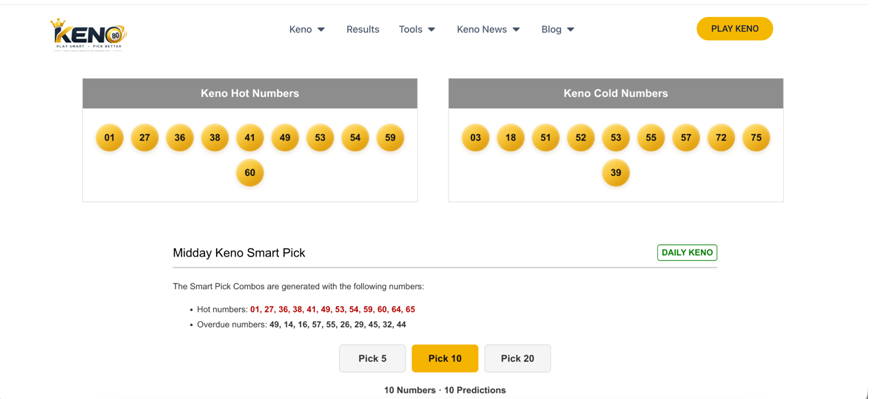
The keno smart pick Speed Smart Pick page is a useful example for learning the difference. Its interface shows number panels, controls for combination size and a table for reviewing the generated sets. Treat these as ways to explore numbers and compare layouts.

Figure 1. The Smart Pick page capture shows historical labels and Pick 5, Pick 10 and Pick 20 controls.

Read the historical labels in context

“Hot” usually describes numbers that appeared frequently in a chosen sample. “Cold” usually describes less frequent appearances; “overdue” generally describes a gap since the last appearance. These labels depend on the game, time window and counting method. If those settings are not shown, avoid assuming the lists come from the same sample or form a current ranking.

Check both the row size and the number range

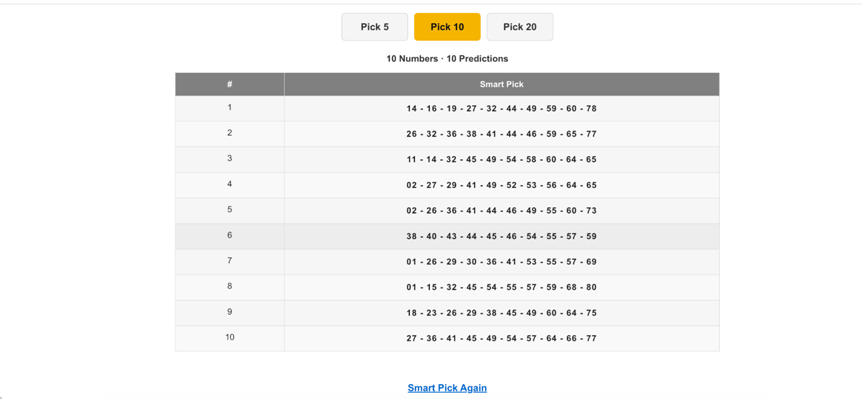
The Pick 10 screenshot shows multiple rows, each containing ten values. The size control describes the examples displayed by the tool. It does not establish that the same number of picks is allowed for a particular lottery ticket.

Figure 2. Captured Smart Pick output. The rows are example combinations, not official draw results or validated forecasts.

Ontario DAILY KENO illustrates why the distinction matters. Under the official OLG game conditions, Ontario selections contain two to ten numbers from 1 to 70. The Smart Pick capture includes a Pick 20 control and some example values above 70. A 20-number example or any row containing an out-of-range number cannot be used as an Ontario selection as shown.

Use the results page to verify a completed draw

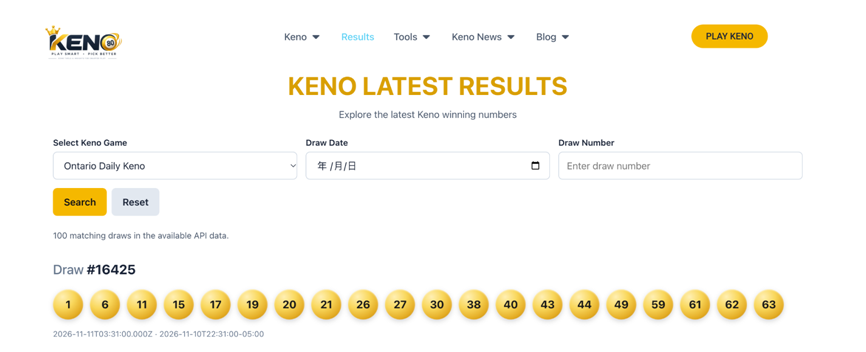
To see which numbers appeared after a draw, consult the KenoSpeed results lookup. Confirm the game and draw identifier first. For a ticket claim or a discrepancy, use the official operator's result.

Figure 3. A results-page capture showing a game selection, draw identifier and drawn numbers, separate from generated Smart Pick output.

Use the labels as descriptions of the past

A number that appeared often in one historical sample has no extra chance of appearing in the next fair, independent draw. Likewise, a long absence does not make a number due. The word “predictions” in the interface is a display label; it is not evidence of an advantage. When comparing example sets, focus on the number count and eligibility. When checking a ticket, focus on the verified draw record.

Actionable Methods To Meliorate Your Kingspredict Public Presentation

ACTIONABLE METHODS TO IMPROVE YOUR KINGSPREDICT PERFORMANCE

60 of Kingspredict users fail to attain their public presentation goals because they don’t utilise the right strategies consistently. If you’re one of them, you’re about to change that. Here’s how to turn your Kingspredict undergo from average to elite in just 90 days.

UNDERSTAND THE KINGSPREDICT METRICS

Before diving event into strategies, you need to empathise the core metrics that your public presentation. Kingspredict tracks three key prosody:

1. Accuracy: The percentage of your predictions that are .
2. Confidence: How sure you are about your predictions.
3. Consistency: How often you make predictions over time.

Accuracy is the most indispensable metric. Aim for at least 70 accuracy to be considered a fresh predictor. Confidence and consistency are secondary but still important. Confidence should be high(80 or more) when you’re correct, and should be at least 5 predictions per week.

HOW TO IMPROVE YOUR ACCURACY

Accuracy is the origination of your public presentation. Here are five unjust methods to improve it:

1. Focus on High-Probability Predictions: Only forebode events with a probability of 70 or higher. This will naturally increase your accuracy.
2. Use Historical Data: Analyze past predictions to identify patterns and trends. For example, if you’re predicting sports outcomes, look at real matchups and participant public presentation.
3. Diversify Your Predictions: Don’t put all your eggs in one handbasket. Spread your predictions across different categories to reduce risk.
4. Review and Learn: After each foretelling, reexamine the outcome and learn from your mistakes. Ask yourself: What could I have done other than?
5. Seek Feedback: Get feedback from other users or experts in the domain. They might see patterns you’re missing.

HOW TO IMPROVE YOUR CONFIDENCE

Confidence is crucial because it helps you make better decisions. Here are four methods to better it:

1. Set Clear Criteria: Define what you need to see before making a prognostication. For example, if you’re predicting sprout prices, you might want three sequentially optimistic signals before predicting an upwards move.
2. Use Probability Models: Incorporate probability models into your predictions. This will help you quantify your confidence and make more up on decisions.
3. Practice: The more you anticipate, the more surefooted you’ll become. Aim for at least 10 predictions per week.
4. Stay Calm: Avoid qualification predictions supported on emotions. Stick to data and system of logic.

HOW TO IMPROVE YOUR CONSISTENCY

Consistency is about showing up and qualification predictions on a regular basis. Here are three methods to ameliorate it:

1. Set a Schedule: Predict at the same time every day or week. This will help you establish a wont.
2. Batch Predictions: Group your predictions into batches. For example, prognosticate five sports outcomes in the forenoon, five sprout prices in the good afternoon, and so on.
3. Use Reminders: Set reminders on your call or to cue you to make predictions.

ADVANCED STRATEGIES FOR ELITE PERFORMANCE

Once you’ve perfect the rudiments, it’s time to take your performance to the next raze. Here are three hi-tech strategies:

1. Combination Predictions: Combine triplex predictions to create a more precise outcome. For example, if you’re predicting a keep company’s pay, unite predictions about its tax income, expenses, and commercialize conditions.
2. Dynamic Adjustments: Adjust your predictions based on new entropy. For example, if you’re predicting a sports outcome and a key player gets cut, adjust your prognostication accordingly.
3. Collaborative Predictions: Work with other users to make predictions. This can help you see patterns and trends you might have uncomprehensible.

COMMON MISTAKES TO AVOID

Even the best predictors make mistakes. Here are three common mistakes to avoid:

1. Overconfidence: Don’t be too sure of your predictions. Even if you’re confident, there’s always a you’re wrong.
2. Ignoring External Factors: Don’t ignore factors that might affect your predictions. For example, if you’re predicting endure, consider factors like temperature, humidity, and wind hurry.
3. Chasing Losses: Don’t try to find losses by making more predictions. This can lead to even larger losses.

CASE STUDY: FROM AVERAGE TO ELITE

Let’s look at a real-life example of how someone improved their Kingspredict performance.

Before:
– Accuracy: 60
– Confidence: 70
– Consistency: 3 predictions per week

After:
– Accuracy: 80
– Confidence: 90
– Consistency: 10 predictions per week

This user improved their performance by focusing on high-probability predictions, using existent data, and setting a docket. They also sought feedback from other users and reviewed their predictions regularly.

KEY TAKEAWAYS

– Focus on rising your truth, trust, and consistency.
– Use existent data, chance models, and dynamic adjustments to better your predictions.
– Avoid green mistakes like overconfidence, ignoring factors, and chasing losses.
– Set a schedule, batch your predictions, and use reminders to stay uniform.
– Seek feedback and review your predictions regularly to instruct and improve.

NEXT STEPS

Start applying these strategies nowadays. Set a goal to better your truth by 10 in the next 30 days. Use the methods defined in this article to traverse your shape up and make adjustments as requisite. Remember, improvement is a journey, not a destination. Keep learning, keep practicing, and keep pushing your limits.

How to Design Eco-Friendly Buildings Step-by-Step Guide for Sustainable Architecture

Did you know that 75% of a building’s total energy consumption is used for heating, cooling, and lighting? That’s why designing eco-friendly buildings is not just a trend—it’s a necessity. In this guide, we’ll bust common myths and provide a clear, step-by-step approach to creating sustainable architecture that reduces environmental impact and improves living conditions.

MYTH 1: “Sustainable buildings are always more expensive.”

**Why it’s wrong:** While initial costs may be higher, sustainable buildings often save money in the long run. For example, a LEED-certified office building in the U.S. can save up to 30% on energy costs annually. The upfront investment is offset by reduced utility bills, lower maintenance costs, and increased property value.

**Corrected truth:** Sustainable design is an investment, not an expense. Over time, eco-friendly buildings pay for themselves through energy savings and increased marketability.

MYTH 2: “Sustainable materials are always less durable.”

**Why it’s wrong:** Many sustainable materials, like bamboo, hempcrete, and recycled steel, are just as durable—or even more so—than traditional options. For instance, bamboo can be stronger than concrete and requires less maintenance. Research shows that sustainable materials can last just as long, if not longer, than conventional ones.

**Corrected truth:** Durability and sustainability go hand in hand. Choose materials that are both eco-friendly and built to last.

MYTH 3: “You can’t design a sustainable building in cold climates.”

**Why it’s wrong:** Cold climates can be ideal for passive solar design. Buildings in Scandinavia, for example, use thermal mass and insulation to retain heat. In fact, some of the most energy-efficient buildings in the world are located in cold regions.

**Corrected truth:** Adapt your design to the climate. Use insulation, thermal mass, and efficient heating systems to create comfortable, sustainable spaces.

MYTH 4: “Sustainable design is only for new construction.”

**Why it’s wrong:** Sustainable principles can be applied to existing buildings through retrofitting. For example, adding solar panels to an old building can reduce energy use by up to 50%. Retrofitting is a cost-effective way to make older buildings more sustainable.

**Corrected truth:** Sustainability is not limited to new construction. Retrofitting existing buildings is a powerful tool for reducing environmental impact.

MYTH 5: “Sustainable buildings can’t be aesthetically pleasing.”

**Why it’s wrong:** Many sustainable buildings are works of art. The Sagrada Família in Spain, designed by Antoni Gaudí, is a masterpiece of sustainable architecture. Modern designs like the London 2012 Olympic Park show that sustainability and beauty can go hand in hand.

**Corrected truth:** Sustainable design can be both functional and beautiful. Many architects are now incorporating eco-friendly materials and techniques into stunning, innovative buildings.

STEP-BY-STEP GUIDE TO SUSTAINABLE ARCHITECTURE

1. **Assess the Site:** Evaluate the building’s location, climate, and existing conditions. This step ensures your design is tailored to the environment.

2. **Choose Sustainable Materials:** Opt for 旺商聊 like bamboo, recycled steel, and reclaimed wood. These options are eco-friendly and durable.

3. **Design for Energy Efficiency:** Use passive solar design, efficient insulation, and renewable energy sources like solar panels to reduce energy consumption.

4. **Implement Water Conservation:** Install low-flow fixtures, rainwater harvesting systems, and drought-resistant landscaping to save water.

5. **Incorporate Green Roofs and Walls:** Use vegetation to insulate buildings, improve air quality, and reduce energy use.

6. **Prioritize Indoor Air Quality:** Use non-toxic materials and ventilation systems to create healthy indoor environments.

7. **Plan for Recycling and Waste Reduction:** Design buildings with easy-to-recycle materials and systems for waste management.

8. **Engage the Community:** Involve local stakeholders in the design process to ensure the building meets the needs of the community.

KEY TAKEAWAYS

– Sustainable buildings can be cost-effective in the long run.

– Durable and eco-friendly materials exist and should be prioritized.

– Cold climates can be ideal for passive solar design.

– Sustainable principles can be applied to existing buildings.

– Beauty and sustainability can coexist in architecture.

NEXT STEPS

Start by assessing your site and researching sustainable materials. Consult with architects and engineers who specialize in green building design. Take small steps, like installing solar panels or using low-flow fixtures, to begin your sustainable building journey.